How it works
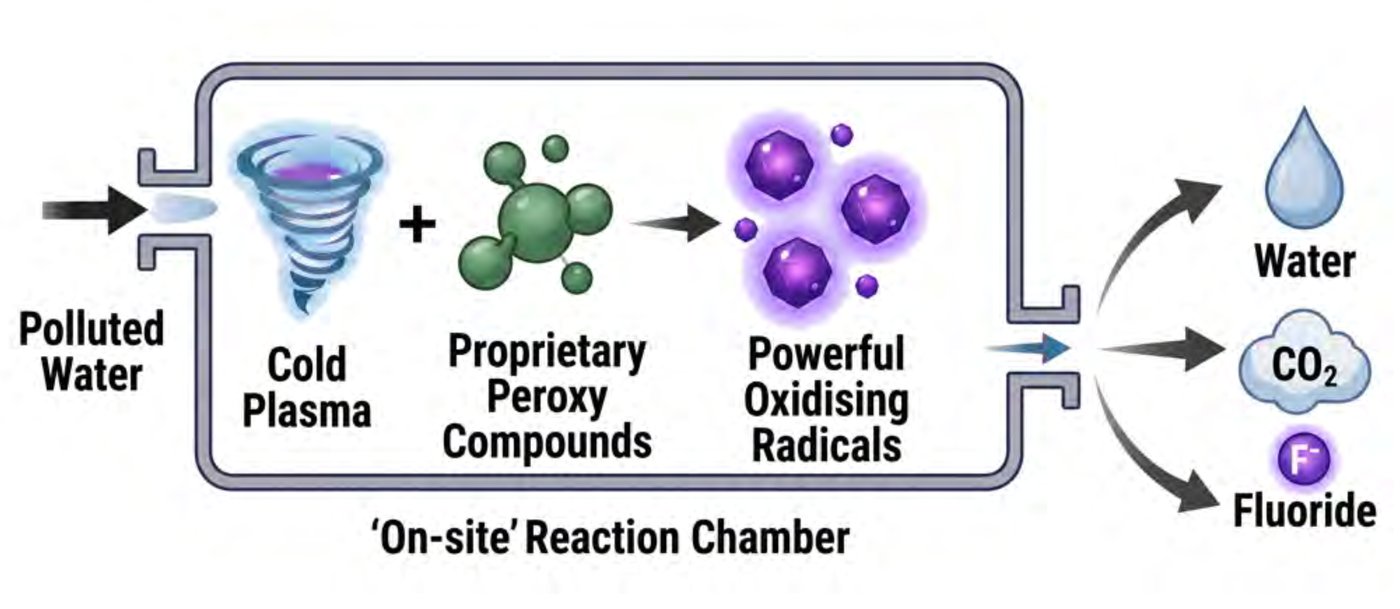
MAOP achieves the total destruction of persistent organic pollutants through fine-tuned interaction of Cold Plasma and a Peroxy mix. This combination generates high-density reactive oxidizing species (ROS) and solvated electrons directly within the aqueous matrix — without removing the contaminant from the water phase.
The synergistic environment facilitates the cleavage of the Carbon-Fluorine (C-F) bond — the highest-enthalpy bond in organic chemistry, responsible for the extreme persistence of PFAS compounds. The process operates at ambient temperature and pressure, delivering oxidising conditions equivalent to supercritical water, electrolysis, or thermal incineration.
Chemical reaction mechanism
Unlike phase-separation technologies (GAC, IX, RO) that merely concentrate pollutants, MAOP is a terminal destruction chemistry. Three sequential reaction pathways drive complete mineralization:
In-Situ Radical Propagation — Plasma-peroxy activation generates a potent mixture of peroxy-compounds, superoxide, and other radicals. This ensures high collision frequency with target contaminants throughout the bulk water volume.
Bond Dissociation & Defluorination — The process is tuned to the resonance frequencies of organic moieties, inducing excitation and subsequent homolytic cleavage of the C-F backbone of PFAS species.
Mineralization Pathway — Resultant intermediate chains undergo rapid decarboxylation and further oxidation. The primary end-products are fluoride ions and CO₂ — no persistent byproducts.
Engineering specifications & performance
| Parameter | Value |
|---|---|
| Treatment time | 2–5 minutes to below detection limit |
| PFAS concentration range | 50–1,000 ppt (single-step) |
| Operating conditions | Ambient temperature and pressure |
| Pre-treatment required | None |
| pH adjustment | Not required |
| Filtration step | Not required |
| Residual reagents | ~1–5 ppm peroxide + trace ozone (drinking water compatible) |
Matrix Resiliency: Reaction kinetics remain robust across a broad range of inorganic co-impurities — no matrix pre-treatment needed.
Single-step, flow-through-ready: The system operates as a standalone unit and can be seamlessly integrated into any existing water treatment infrastructure.
Key advantages
- Terminal destruction — not separation or concentration of PFAS
- Achieves below detection limit at 50–1,000 ppt PFAS within 2–5 minutes
- No pre-concentrating, no pH modifiers, no filtration step
- Operates at ambient temperature and pressure
- Compatible with existing infrastructure — no major civil works required
- Only trace residuals: ~1–5 ppm peroxide and residual ozone, both drinking-water compatible
Get a quote
Describe your contamination challenge to our AI Consultant or contact us directly.